Holmenkollen: How an Oslo hillside built modern skiing — and Norway's second national day
From a 21.5-metre leap off snow and twigs in 1892 to a 150,000-strong Olympic crowd in 1952 and a 1,000-tonne cantilevered steel tower, the story of Holmenkollen explains why skiing sits at the heart of Norwegian identity.
- Coverage
- Norway
- Verification
- ✓ 6 sources checked ↓
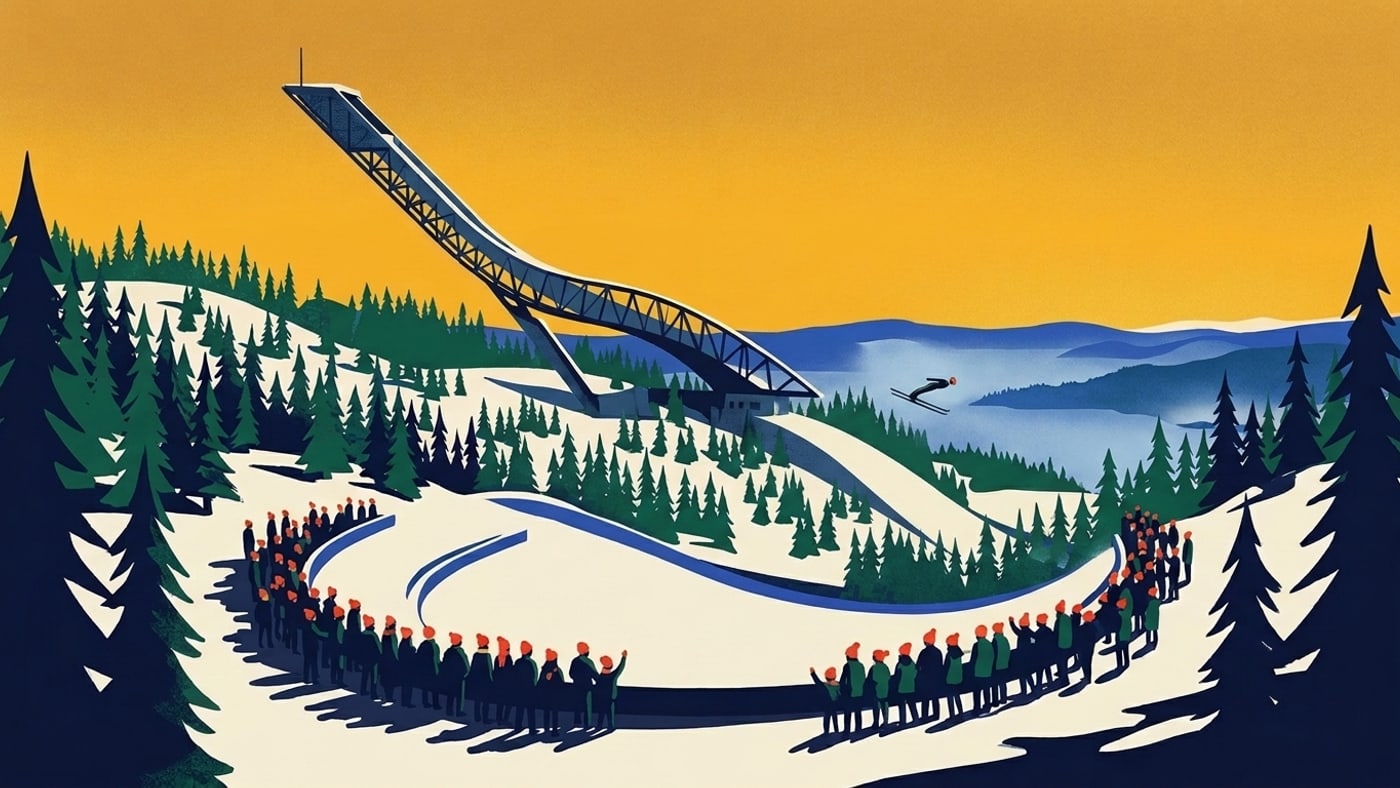
Stand almost anywhere along Oslo’s harbour on a clear winter afternoon, look north-west towards the forested ridge of Nordmarka, and one silhouette immediately catches the eye: a pale silver curve jutting cleanly out of the spruce trees like a ship’s prow suspended in mid-air. That structure is Holmenkollbakken — the Holmenkollen ski jump — and for more than 130 years it has been far more than a sports stadium.
Norwegians often refer to Holmenkollen Sunday (Holmenkollsøndagen), the climax of the annual March ski festival, as the country’s “second national day”, second only to 17 May. For anyone who moved to Norway from abroad, the devotion can feel baffling at first: why do tens of thousands of people willingly take a packed mountain metro up into freezing fog, camp in snowdrifts with flags and thermoses, and cheer strangers flying off a hillside?
The answer is stitched directly into the history of how Norway became a modern nation.
Snow, twigs and 12,000 spectators in 1892
Skiing in Norway is thousands of years old — originally a matter of winter survival, hunting and transport rather than leisure. Organised competition arrived only in the late nineteenth century, led by Skiforeningen (the Association for the Promotion of Skiing), founded in 1883.
On 30 January 1892, Skiforeningen hosted the very first ski-jumping competition at Holmenkollen. There was no concrete tower, no elevator and no wind screen — only a natural snow-covered hillside with a take-off ramp packed together from snow and twigs. Yet around 12,000 spectators made the winter trek up the hill to watch.
Back then, ski jumping was not a standalone spectacle. The inaugural festival tested complete Nordic skiers: competitors raced an 18-kilometre cross-country course on one day and jumped on the next, expected to master both endurance and nerve. The winning jump in 1892 measured 21.5 metres — barely a fifth of what modern World Cup jumpers clear on the same ridge today, yet enough to turn the hillside into an instant national stage.

A royal jumper and the world’s oldest ski museum
In Norway, skiing was never solely a working-class pastime or an aristocratic club — it became a shared civic ritual. Nothing cemented that more memorably than the Norwegian royal family. Long before he became known as Folkekongen (the People’s King) and the “Skiing King”, Crown Prince Olav — later King Olav V — competed as an active ski jumper at Holmenkollen in 1922 and 1923, recording jumps of around 38 metres in front of the public. In a young independent nation (Norway dissolved its union with Sweden in 1905), seeing the heir to the throne hurl himself down the same hill as ordinary citizens became an enduring symbol of Norwegian egalitarianism.
The very same year, 1923, architect Hjalmar Welhaven founded the Holmenkollen Ski Museum (Skimuseet) — today the world’s oldest specialised ski museum. It first opened in a timber building higher up the ridge at Frognerseteren, displaying historical skis alongside expedition equipment carried by Norway’s celebrated polar explorers Fridtjof Nansen and Roald Amundsen.
Meanwhile, the jump itself could never sit still. As skis improved and athletes flew farther, Holmenkollen had to be reshaped again and again. Wooden scaffolding towers went up and came down — one towering 1920s timber frame, nicknamed the “Tower of Babel”, famously collapsed in 1927 — before stone and concrete took over. In total, the hill has been rebuilt or substantially modified nearly 20 times, including major upgrades ahead of the FIS Nordic World Ski Championships in 1930, 1966, 1982 and 2011.
1952: The day 150,000 people packed the bowl
Holmenkollen’s defining global moment arrived with the VI Olympic Winter Games in Oslo in 1952 — the first Winter Olympics held in a capital city, and the first in the birthplace of modern Nordic skiing.
To prepare, Skiforeningen and Oslo transformed the hillside. A taller, iron-reinforced concrete jumping tower rose with an internal elevator for athletes; permanent spectator stands, judges’ towers and royal boxes appeared for the first time; and the pond at the foot of the landing slope was excavated so jumpers had room to land safely. At the same time, the Ski Museum moved down from Frognerseteren into its iconic home built directly underneath the jumping ramp (later expanded with rock-blasted galleries inside the mountain for its 1983 anniversary).
On Olympic ski-jumping day, an estimated 120,000 to 150,000 spectators crowded into the natural amphitheatre — an Olympic ski-jumping attendance record that has never been matched. Photographs from that winter show a sea of coats and wool hats stretching up into the pine forest, turning a winter contest into a moment of collective post-war renewal.
Demolishing a monument to save it
By the late 2000s, the beloved 1952 concrete tower was showing its age and struggling with modern international wind and safety rules. Ahead of the 2011 FIS Nordic World Ski Championships, Oslo made a bold call: between 2008 and 2010, the historic concrete jump was demolished completely.
In its place rose an international competition winner designed by JDS Architects (led by Julien De Smedt): a sweeping cantilevered structure built from roughly 1,000 tonnes of steel, rising approximately 58 to 60 metres into the air. Its curved profile was not just sculptural drama — it integrates built-in wind protection along the in-run, housing the judges’ booths, royal box, ski lounge and a public observation deck inside one continuous steel form, paired with a modernised Ski Museum entrance below.
Every March, the FIS World Cup still returns to the bowl. Even on quiet mid-week mornings outside competition season, the hillside stays busy with cross-country skiers setting off into Nordmarka on the very trails that Skiforeningen still grooms.
How to experience it today
You do not need skis — or a March festival ticket — to understand why Holmenkollen matters. Take Oslo’s T-bane Line 1 uphill to Holmenkollen station (check Ruter during planned track works) and walk up to the arena for one of the widest views over Oslo and the Oslofjord.
- Holmenkollen Ski Museum & Jump Tower (Skimuseet): Open daily year-round — 10:00–16:00 from October to April and 10:00–17:00 from May to September (10:00–14:00 on 17 May, 24 December and 31 December). Standard admission includes both the museum (covering thousands of years of skiing and polar exploration) and the elevator to the top of the jump tower: NOK 200 adult, NOK 150 under 30, NOK 100 child (6–17), free under 6, NOK 500 family (2 adults + 2 children) or NOK 600 (2 adults + 3 children). The optional Ski Simulator costs NOK 130 adult / NOK 75 child. holmenkollen.com · skiforeningen.no · Map
- Frognerseteren (where the Ski Museum began in 1923): Further up Line 1 at the edge of Nordmarka’s forest trails. Map
Fact-checked sources
✓ 6 sources verified
Produced by our AI-assisted lifestyle desk and checked claim-by-claim against these public sources before publication.
- Skiforeningen — Holmenkollen and Ski Museumskiforeningen.no ↗
- Holmenkollen Ski Museum & Jump Tower — History and Visitor Informationholmenkollen.com ↗
- VisitOSLO — Holmenkollen Ski Museum and Ski Jumpvisitoslo.com ↗
- Olympics.com — Oslo 1952 Winter Games & Holmenkollenolympics.com ↗
- The Royal House of Norway — King Olav Vroyalcourt.no ↗
- JDS Architects — Holmenkollen Ski Jumpjdsa.eu ↗
Found a mistake? See corrections.