Beyond The Scream: How Oslo's hills, family grief and a fjord summer village shaped Edvard Munch
Everyone knows the screaming figure under a blood-red sky, yet far fewer know there are four versions, two dramatic Norwegian art heists, and a quiet wooden cottage on the Oslofjord where Edvard Munch painted his most luminous works.
- Coverage
- Norway
- Verification
- ✓ 5 sources checked ↓
In Norway, Edvard Munch is everywhere and nowhere at once. His most famous image — a wide-eyed figure clutching its head beneath a rippling orange-red sky — has become universal shorthand for modern anxiety, printed onto tote bags, coffee mugs and emoji keyboards around the world. Yet walk through Oslo’s waterfront or take a slow train down the western shore of the Oslofjord, and a far richer, stranger and more deeply Norwegian portrait emerges.
Munch (1863–1944) was not a one-hit painter of panic. He was a relentless experimenter who painted out of doors in winter snow, guarded his canvases like family members, returned obsessively to the same coastal shoreline for decades, and left almost everything he owned to the city of Oslo.
Grief in Kristiania and a walk on Ekeberg
Born on 12 December 1863 in Løten in eastern Norway, Edvard Munch grew up in Kristiania — as Oslo was known until 1925 — in a household shadowed by loss. Both his mother and his elder sister died of tuberculosis while he was young, and his father struggled with severe mental distress. Those early bereavements became the emotional spine of Munch’s art: sickness, grief, jealousy, longing and the fragile boundary between sanity and collapse.
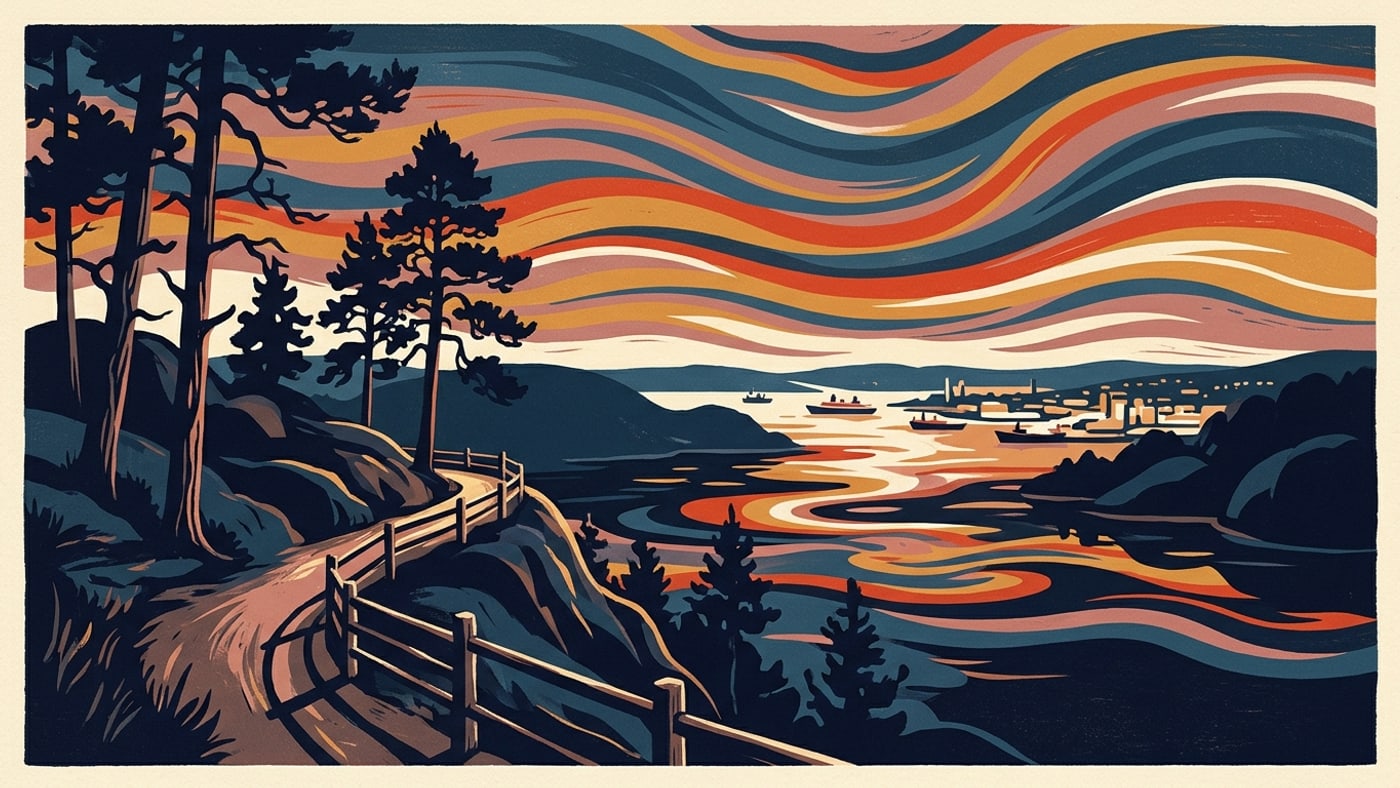
The exact scene behind The Scream (Skrik) was not invented in a studio. It came from a real walk along a hillside road at Ekeberg, looking down over Oslo harbour and the Oslofjord. In a diary entry dated January 1892, Munch described walking with two companions as the sun went down and the clouds suddenly turned blood-red. Feeling “a breath of melancholy” and a sudden tremor of exhaustion and dread, he wrote that he stood trembling while he “sensed an endless scream passing through nature” (translated from Norwegian).
Rather than painting a literal sunset, Munch tried to paint what that moment felt like from the inside — bending the fjord, the sky and the railing into rhythmic, vibrating waves.
Four Screams — and a faint pencil mystery
One surprise for newcomers visiting Oslo’s museums is discovering there is not just one Scream. Between 1893 and roughly 1910, Munch created four primary versions in paint and pastel, alongside an 1895 lithographic stone from which he pulled multiple prints (some hand-coloured):
- 1893 (oil, tempera and pastel on cardboard): The most famous painted version, now displayed at Nasjonalmuseet (Norway’s National Museum) in Oslo. High in the upper-left sky sits a tiny, barely visible pencil inscription in Norwegian: “Kan kun være malet af en galning” — “Can only have been painted by a madman” (translated from Norwegian).
- 1893 (crayon and pastel on cardboard): An early pastel version held in the permanent collection of Oslo’s MUNCH museum.
- 1895 (pastel on board): The only version to remain in private hands, inscribed by Munch on its wooden frame with his prose poem about the Ekeberg walk. Consigned by Norwegian businessman Petter Olsen, it sold at Sotheby’s New York on 2 May 2012 for USD 119,922,500, setting a world auction record at the time.
- c. 1910 (tempera and oil on unprimed cardboard): A bold later painting also held at MUNCH in Oslo. Because works on cardboard and paper are highly sensitive to light, MUNCH rotates its versions on view carefully so visitors see one version at a time while the others rest in darkness.
Two brazen Norwegian art heists
Few paintings in history have had more dramatic second lives than The Scream — twice stolen in Oslo, ten years apart.
The first heist happened on 12 February 1994, the very morning the Winter Olympics opened in Lillehammer and police attention was stretched thin. Thieves propped a ladder against a window of Oslo’s old National Gallery (Nasjonalgalleriet), smashed the glass, cut the 1893 painting from the wall and left behind a postcard-style taunting note: “Thousand thanks for the bad security!” (translated from Norwegian). After a failed ransom demand and an undercover sting involving Norwegian police and British Scotland Yard detectives, the painting was recovered undamaged on 7 May 1994 at a hotel in Åsgårdstrand — ironically, Munch’s own beloved summer town.
Ten years later, in August 2004, masked armed robbers walked into the Munch Museum in broad daylight, threatened staff and visitors, tore the c. 1910 The Scream and Madonna straight off the wall, and fled. Norwegian police recovered both paintings in 2006, after which conservators painstakingly stabilised and restored them.
Åsgårdstrand, Ekely and the gift that built a museum
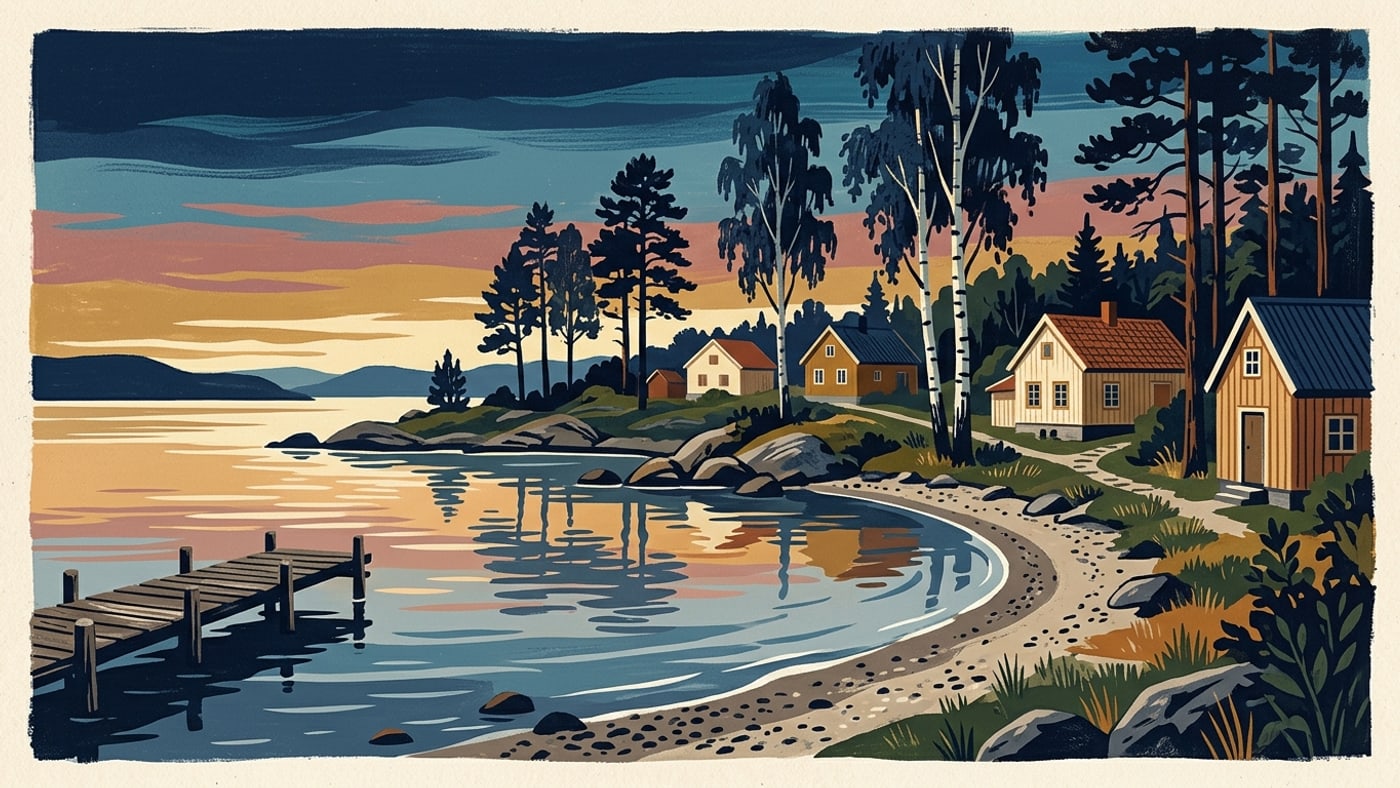
To see the calmer, more sunlit side of Munch, look away from the screams and towards the water. In 1898, Munch bought a modest yellow wooden house in Åsgårdstrand, a quiet coastal village on the western side of the Oslofjord. Its curved pebble beach, shoreline boulders, white picket fences and bright summer twilight appear again and again in masterpieces such as The Dance of Life and Melancholy. Preserved largely as he left it, the cottage still operates as a house museum.
In 1916, Munch purchased Ekely, a spacious estate and former market garden at Skøyen on the western outskirts of Oslo, where he lived and painted for the final 28 years of his life. Working on an increasingly monumental scale — and famously willing to leave canvases outdoors in wind and snow to weather them — he built open-air studios alongside a brick Winter Studio designed by architect Arnstein Arneberg in 1919–1920 and expanded by Henrik Bull in 1929.
When Munch died at Ekely on 23 January 1944, Norway was under German wartime occupation and few realised how vast his personal hoard had become. He had kept thousands of his works beside him, calling them his “children”. In his will, he bequeathed his entire remaining collection unconditionally to the City of Oslo — roughly 1,100 paintings, 4,500 drawings and watercolours, and thousands of prints, together with notebooks, tools and woodcut blocks. That extraordinary gift created the original Munch Museum in 1963 and anchors today’s towering Bjørvika waterfront museum, MUNCH.
Following Munch’s footsteps today
If you live in Norway, Munch’s world is remarkably easy to visit in person:
- MUNCH (Bjørvika, Oslo): Holds the world’s largest Munch collection, including rotating displays of the c. 1910 painted The Scream, the 1893 pastel, and lithographs. munchmuseet.no · Map
- Nasjonalmuseet (Vestbanen, Oslo): Houses the 1893 painted The Scream alongside major works from The Frieze of Life. nasjonalmuseet.no · Map
- Ekeberg hillside viewpoint (Oslo): The ridge overlooking Oslo harbour and the Oslofjord tied to Munch’s January 1892 diary entry. visitoslo.com · Map
- Edvard Munch’s Studio at Ekely (Skøyen, Oslo): Munch’s protected brick Winter Studio and grounds, opened periodically for cultural events and exhibitions. edvard-munchs-atelier.no · Map
- Munch’s House in Åsgårdstrand (Vestfold): His preserved 1898 coastal summer home by the fjord (seasonal opening — check hours before travelling). visitnorway.com · Map
Fact-checked sources
✓ 5 sources verified
Produced by our AI-assisted lifestyle desk and checked claim-by-claim against these public sources before publication.
- MUNCH Museum — Edvard Munch, Biography and Collectionsmunchmuseet.no ↗
- Nasjonalmuseet — Edvard Munch, The Scream (1893)nasjonalmuseet.no ↗
- Edvard Munch's Studio at Ekely — Historyedvard-munchs-atelier.no ↗
- Visit Norway — In the Footsteps of Edvard Munch (Åsgårdstrand & Oslo)visitnorway.com ↗
- VisitOSLO — Edvard Munch in Oslovisitoslo.com ↗
Found a mistake? See corrections.